


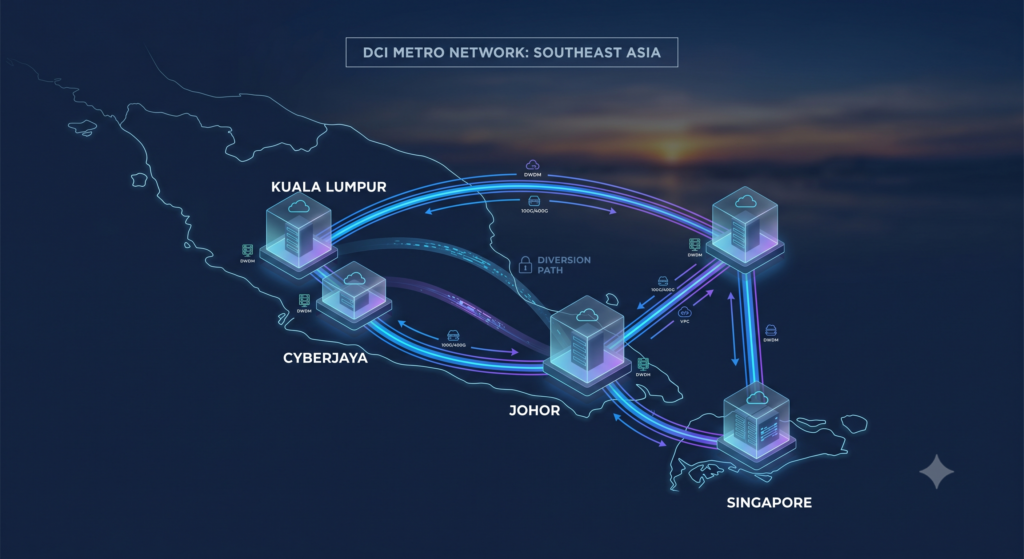

If you’ve ever wondered how data in one data centre reaches another data centre hundreds or even thousands of kilometres away — the answer is Data Centre Interconnect (DCI).
It’s one of those terms that sounds more complicated than it actually is. So let’s break it down.
DCI in Plain English
At its simplest, DCI is a high-speed connection between two or more data centres. Think of it as a dedicated private highway for data — no traffic jams, no sharing lanes with public internet traffic, just fast, reliable, and secure connectivity.
A DCI link can connect:
- Two data centres within the same city (metro DCI)
- Data centres across different countries (long-haul DCI)
- Multiple data centres in a mesh or hub-and-spoke topology
The goal is always the same: move data between locations fast, securely, and with predictable performance.
Why Do You Need DCI?
You might be thinking: “Can’t I just use the internet?”
Technically yes, but practically… not if you care about reliability, speed, or security. Here’s why DCI wins over the public internet:
| Factor | Public Internet | Dedicated DCI |
|---|---|---|
| Latency | Variable (jitter) | Predictable & low |
| Bandwidth | Shared, contended | Dedicated, guaranteed |
| Security | Exposed to threats | Private/encrypted link |
| SLA | Best-effort | 99.9%+ uptime guarantee |
| Data transfer | Can be slow for large volumes | 10G/100G/400G speeds |
Real-world use cases:
- 🏢 Enterprise — connecting HQ to a colocation facility or DR site
- ☁️ Hybrid cloud — linking on-prem data centres to cloud providers
- 📦 Content delivery — replicating data across regional PoPs
- 🔄 Disaster recovery — real-time replication between active and backup sites
- 📊 Big data — moving large datasets between processing locations
The Technology Behind DCI
DCI isn’t magic — it’s built on a few well-established technologies:
1. Dark Fibre
Leasing unlit fibre optic cables between locations. You provide the optics and equipment on both ends. Gives you full control over speed and protocol.
2. Wavelength (Lambda)
A dedicated wavelength of light on a shared fibre pair. Think of it as your own private lane on a fibre highway. Common speeds: 10G, 100G, up to 400G per wavelength.
3. MPLS / EPL (Ethernet Private Line)
A managed Layer 2 or Layer 3 connection between sites. The provider handles the transport — you just plug in and go. EPL is a popular choice for enterprises that want simplicity.
4. SD-WAN over DCI
Software-defined WAN overlays on top of dedicated DCI links. Gives you application-aware routing, traffic shaping, and automated failover while keeping the performance of dedicated fibre.
At X86 Network, we deliver DCI using a self-healing mesh network with automatic failover in milliseconds — so even if a fibre cut happens on one route, your data keeps flowing.
Common DCI Topologies
How you connect your data centres depends on what you’re trying to achieve:
    Metro DCI                  Multi-Site Mesh
 ┌─────────┐   10km   ┌─────────┐
 │   DC A  │ ════════ │   DC B  │       DC A ──── DC B
 └─────────┘          └─────────┘          │  \    /  │
                                           │    X    │
    Active-Active HA                      DC C ──── DC D
 ┌─────────┐    ┌─────────┐
 │   DC A  │════│   DC B  │    Both live, traffic split
└─────────┘ └─────────┘ across both sites- Point-to-point — simplest, two data centres connected directly
- Hub-and-spoke — central DC connects to multiple edge sites (common for enterprises)
- Mesh — every DC connected to every other (most resilient, but more complex)
- Ring — data centres in a loop with automatic rerouting
DCI vs CDN vs Cloud — What’s the Difference?
This is a common point of confusion, so let’s clear it up:
| Service | What it does | Best for |
|---|---|---|
| DCI | Connects your data centres | Private, fast, large-scale data transfer |
| CDN | Caches content closer to users | Delivering web content, video, downloads |
| Cloud | Provides compute/storage on demand | Scalable apps, SaaS, elastic workloads |
They’re complementary, not competing. Many organisations use all three: DCI to connect their DCs, CDN to serve content to users, and cloud for burst capacity.
Getting Started with DCI
Not sure if you need DCI? Ask yourself these questions:
- ✅ Do you operate two or more data centre locations?
- ✅ Do you need to move large amounts of data between them regularly?
- ✅ Is latency and reliability critical for your applications?
- ✅ Are you planning disaster recovery or business continuity?
- ✅ Do you want predictable bandwidth costs instead of variable internet charges?
If you answered yes to any of the above, DCI is worth exploring.
Good news: you don’t need to be a hyperscaler. X86 Network offers DCI from 10G up to 100G per link with next-business-day activation on major routes — no minimum commitment that breaks the bank.
Quick Recap
| 💡 | Key takeaway |
|---|---|
| DCI = private high-speed link between data centres | |
| Faster, more secure, and more reliable than the public internet | |
| Built on dark fibre, wavelengths, or Ethernet private lines | |
| Essential for DR, hybrid cloud, and large-scale data transfer | |
| You don’t need to be a giant to use it — DCI is for everyone |
Have questions about DCI for your setup? We’re always happy to chat — reach out to our team anytime.