How can a light signal, which clearly represents energy be “negative”?
The short answer is that optical signal level is not measuring zero energy, it is measuring a ratio. In fiber optics, signal level is measured in dBm (decibel-milliwatts). This is a logarithmic scale that compares the signal power to a standard reference of 1 milliwatt (mW). A negative number simply means the power level is less than 1 mW. Fiber optic power measurement is used to quantify optical signal strength by comparing transmitted light levels against a standard reference in decibels (dBm).
Here is a breakdown of why this system is used and how to read it.
1. The Reference Point: 0 dBm
To measure anything on a decibel scale, you need a “zero” point to compare against. In optical fiber, that zero point is 1 milliwatt.
- 0 dBm = 1 mW
If you have a signal of exactly 1 milliwatt, your meter will read 0 dBm.
2. The Conversion Formula
To calculate the decibel level from raw power, we use a logarithmic formula. This formula explains exactly how a specific wattage converts to a dBm reading:
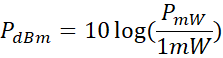
Because the log of a number smaller than 1 is always negative, any power input (PmW) that is less than 1mW results in a negative dBm value.
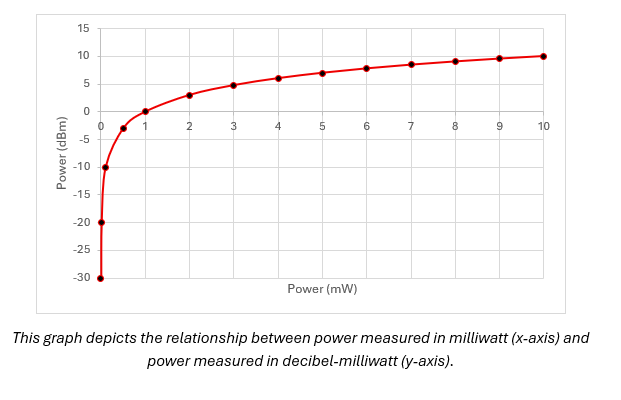
You can visualize the signal strength using this simple comparison table. Note that every time you go down by 3 dB, you cut the power in half.
| Measurement (dBm) | Actual Power (mW) | Context |
| +10 dBm | 10 mW | Strong signal (Amplifier/Transmitter) |
| 0 dBm | 1 mW | The Reference Point |
| -3 dBm | 0.5 mW | Half the reference power |
| -10 dBm | 0.1 mW | 1/10th of a milliwatt |
| -20 dBm | 0.01 mW | 1/100th of a milliwatt |
| -40 dBm | 0.0001 mW | Very weak signal (Likely failure) |
3. Negative Means “Fraction,” Not “Loss”
Because the scale is logarithmic, positive numbers represent multiplication, and negative numbers represent division (fractions).
- Positive dBm (+): The signal is stronger than 1 mW.
- Negative dBm (-): The signal is weaker than 1 mW.
1 milliwatt is a strong signal. By the time light travels through kilometers of glass fiber, it attenuates (weakens) significantly. Therefore, the light arriving at the receiver is almost always a tiny fraction of a milliwatt.
4. Attenuation vs. Signal Level
This is where most people get confused. While the signal level is usually negative (e.g. -15 dBm), the attenuation (loss) is usually expressed as a positive number (e.g. 3 dB).
Attenuation describes the magnitude of the loss. We do not say “the cable has -3 dB of loss” because that would be a double negative (implying a gain). Instead, we say:
- The signal dropped from -10 dBm to -13 dBm. Or
The Attenuation is 3 dB.
5. Why don’t we just use Watts?
We use decibels because optical signal loss is exponential.
- If you have a fiber that loses 50% of its light every 15km, calculating the remaining wattage after 100km requires complex multiplication of fractions (0.5×0.5×0.5x….).
- With decibels, you simply subtract. If you start with -5 dBm and lose 3 dBm (attenuation) along the way, you arrive with -8 dBm. It makes the math much simpler for network engineers.
Summary
If your optical power meter reads -15 dBm, do not worry. It does not mean you have no light. It means you have 15 decibels less power than 1 milliwatt, which is a good signal level for most fiber optic networks.